
Master Thesis — Community detection for time varying networks
My first step into research started with my Master’s thesis (2016-2017) on large time-varying networks with Prof. Jean-Charles Delvenne.
- Antoine Aspeel. Community Detection in Large-Scale Time-Varying Networks, A Modularity Based Approach, 2017
In my Master’s thesis, we developed fast optimization methods for community detection in time-varying graphs, that is, graphs where nodes and edges are added and removed. This work led to the following publications in SIAM journals:
Michaël Fanuel, Antoine Aspeel, Michael T Schaub, Jean-Charles Delvenne. Ellipsoidal embeddings of graphs. SIAM Journal on Applied Mathematics, 2024.
Michaël Fanuel, Antoine Aspeel, Jean-Charles Delvenne, and Johan AK Suykens. Positive semi-definite embedding for dimensionality reduction and out-of-sample extensions. SIAM Journal on Mathematics of Data Science, 2022.
A common paradigm for community detection is to find a partition of the nodes that maximizes the modularity, a measure of the quality of the partition with respect to the graph structure [1].
The Louvain method has been proposed as an efficient heuristic to maximize modularity [2]. It proceeds by creating a hierarchical community structure: nodes are grouped into communities, and communities are grouped into communities-of-communities, etc. While offering computational benefits, the Louvain method and its hierarchical structure are not well-suited for time-varying graphs.
Challenge: Classical community detection methods, such as the Louvain algorithm, are not well-suited for time-varying graphs. When the graph changes, these methods require recalculating the community structure from scratch, failing to leverage previous computations to adapt efficiently to the changes.
Solution: To face this issue, the method I developed in my Master’s thesis is based on graph embedding, where each node of the graph is associated with a point on a \((r-1)\)-dimensional sphere \(\mathbb{S}^{r-1}\subset\mathbb{R}^r\). Then, modularity maximization is relaxed into a smooth optimization problem over the sphere. The manifold structure of the sphere allows to use efficient methods for constrained optimization [3]. Then, the community structure of the graph is obtained by clustering the points on the sphere using the \(k\)-means algorithm.
A key advantage of our embed-and-partition approach is its adaptability to time-varying graphs. When the graph undergoes changes, the existing embedding can serve as a warm start for the iterative optimization process, significantly reducing computational time.
Embeddings are low dimensional
A natural question that arises when using our method is how to choose the embedding dimension \(r\) for the sphere \(\mathbb{S}^{r-1}\). Indeed, this is a user-defined parameter with no a priori upper bound. In addition, using a large \(r\) increases the dimension of the optimization problem, leading to more computation time.
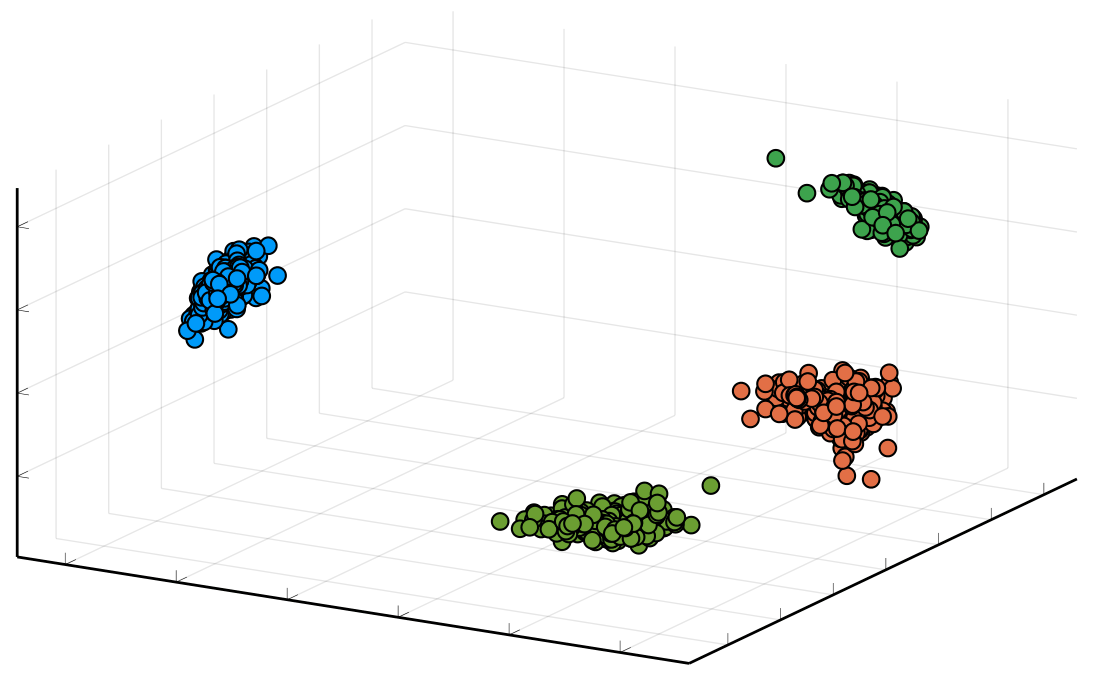
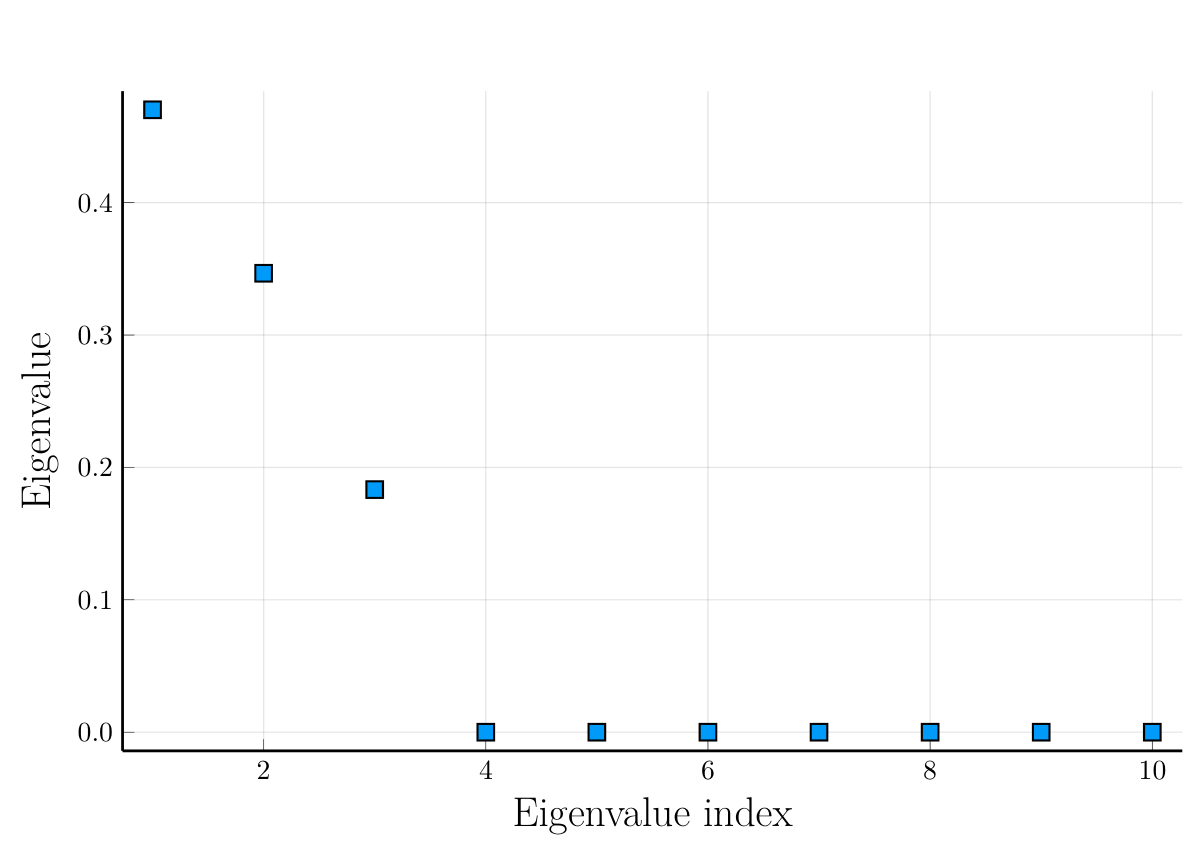
However, numerical demonstrations show that the optimal embedding is often very low dimensional, allowing one to choose a small value for the embedding dimension \(r\) without compromising the quality of the solution (see figures below). We have been able to provide a theoretical explanation to the low dimensionality of the embeddings. Indeed, we proved that the optimization problem we are solving to find the graph embedding is equivalent to a nuclear norm minimization subject to linear constraints. Since the nuclear norm is the tightest convex relaxation of the rank [4], it promotes low rank solutions which correspond to low-dimensional embeddings. This finding provides theoretical support for the use of low-dimensional embeddings, resulting in significant reductions in computation time.
References
[1] M. E. Newman and M. Girvan, “Finding and evaluating community structure in networks,” Physical review E, vol. 69, no. 2, p. 026 113, 2004.
[2] V. D. Blondel, J.-L. Guillaume, R. Lambiotte, and E. Lefebvre, “Fast unfolding of communities in large networks,” Journal of statistical mechanics: theory and experiment, vol. 2008, no. 10, P10008, 2008.
[3] P.-A. Absil, R. Mahony, and R. Sepulchre, Optimization algorithms on matrix manifolds. Princeton University Press, 2008.
[4] M. Fazel, H. Hindi, and S. P. Boyd, “A rank minimization heuristic with application to minimum order system approximation,” in Proceedings of the 2001 American Control Conference., IEEE, vol. 6, 2001, pp. 4734–4739.